


Bedroom Layout Ideas for Small Rooms That Actually Work
Small bedroom? No problem. The right layout can turn even the tightest space into a room you genuinely love waking up in. Here are the practical ideas to help you make it happen.
Let’s be honest: small bedrooms can feel frustrating. You want a space that feels calm, organized, and yours, but every time you move a piece of furniture, something just feels off. The bed is too big, the wardrobe blocks the window, or you’re tripping over the desk chair every morning.
Here’s the thing though: the size of your room is rarely the real problem. In most cases, it’s the layout that’s working against you, not the square footage.
I’ve spent a lot of time looking at what actually works in compact bedrooms, and what I keep coming back to is this: when you nail the layout, everything else falls into place. Light comes in properly, the room breathes, and you stop bumping into furniture. So let’s walk through 7 solid bedroom layout ideas for small rooms that are tried, tested, and genuinely useful.
A well-arranged small room will almost always feel more comfortable than a poorly arranged large one. It’s not about the size, it’s about the logic behind the arrangement.
Why Layout Matters More Than Room Size
Before we get into the ideas, I want to make one thing clear. You don’t need to renovate your room, buy all-new furniture, or knock down a wall to fix a small bedroom. Most of the time, you just need to rethink where things go.
Good bedroom layout ideas for small rooms all share a few things in common:
First, they keep the floor clear. Visible floor space, even just a little of it, tricks your eye into thinking the room is bigger than it is. Second, they use walls wisely. A wall-mounted shelf or a floating nightstand does the same job as a floor-standing piece, but without eating up your precious walking path. Third, they respect light. No piece of furniture should block the window more than absolutely necessary.
Keep those three things in mind as you read through these ideas, and you’ll start to see how they apply in very different ways.
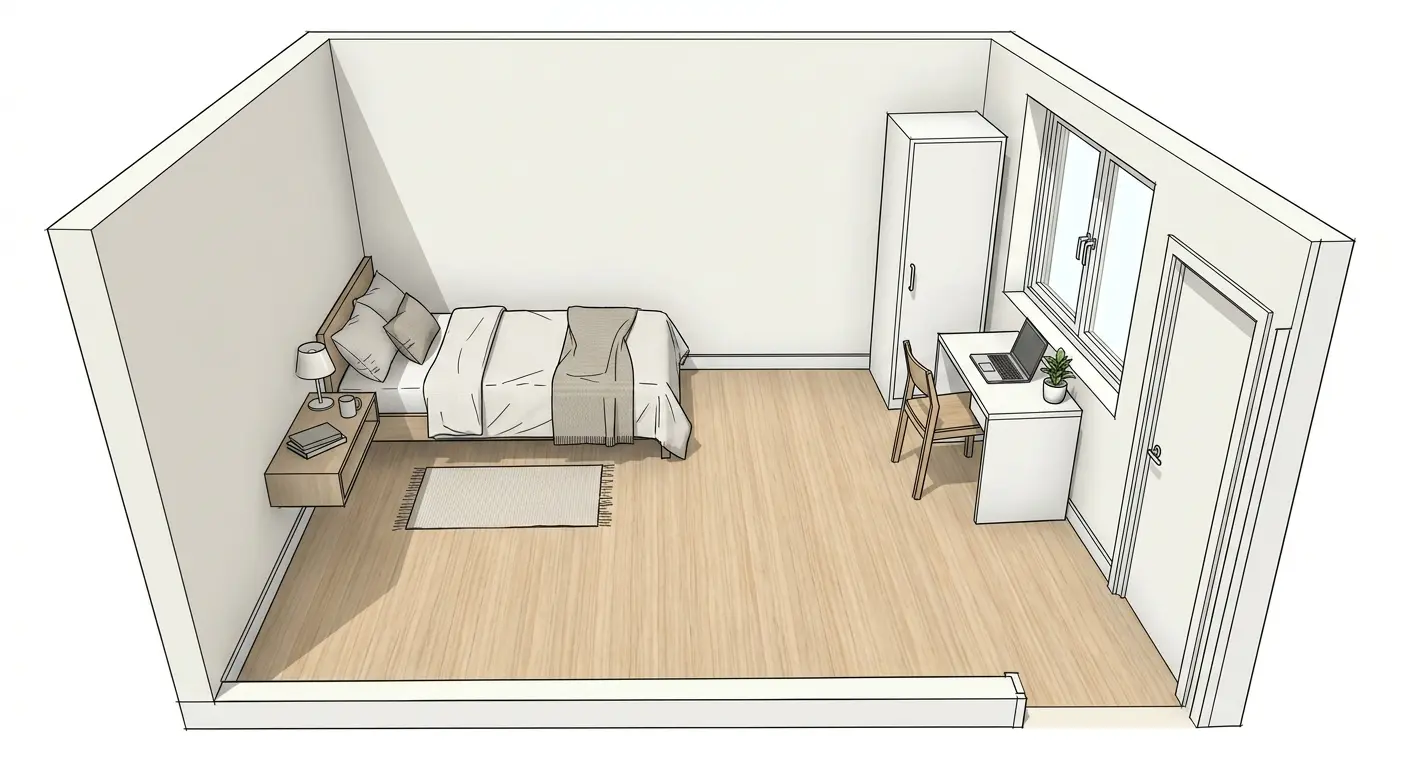
This is one of the most underrated bedroom layout ideas for small rooms, and it’s beautifully simple: push the bed into a corner, flush against two walls, and suddenly you have two full sides of the room free to breathe.
The benefit is obvious once you try it. Instead of needing walkway space on both sides of the bed, you only need one. That’s anywhere from 18 to 36 inches of recovered floor space, which is significant in a small room.
The sketch above shows this working really well in a room of roughly 12 square meters. The bed sits in the far-left corner with the head against the back wall. A floating shelf replaces a floor-standing nightstand, keeping the floor line completely clear. The result is a diagonal walking path from the door to the desk that never feels cramped.
To make getting in and out of a corner bed easier, add a small step stool or a low bench at the foot. It solves the “climb over” problem without taking up much room at all.
If you’re sharing the bed and both people need access, this layout won’t be ideal. But for solo sleepers or kids’ rooms, it’s one of the smartest arrangements you can make in a tight space.
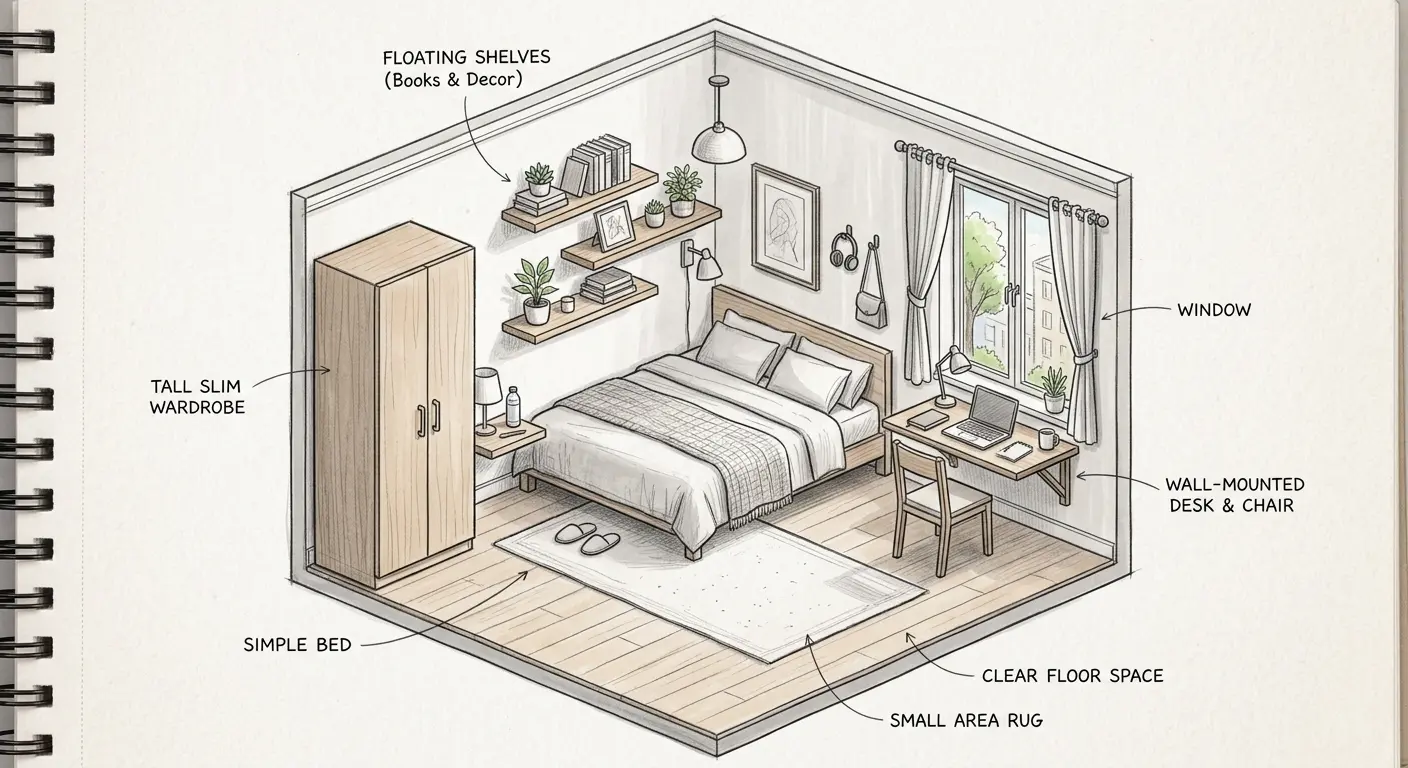
Here’s a layout strategy that transforms a small room without changing its dimensions at all: go vertical, mount everything possible to the wall, and let the floor do nothing but exist.
In the layout shown above, based on a roughly 9 by 12 foot room, the desk has no legs. It’s wall-mounted under the window, supported by heavy-duty brackets. The nightstand is a cantilevered shelf. Three staggered floating shelves sit above the bed where a gallery wall would normally go. Together, these choices keep about 15% more of the floor visible compared to a standard furniture arrangement.
That number doesn’t sound huge, but you’ll feel it. Visible floor makes a room feel easy to navigate. It makes morning cleaning take seconds instead of minutes. And visually, it gives your eye a place to rest.
This is one of those bedroom layout ideas for small rooms that also just looks clean and intentional. Wall-mounted furniture tends to read as modern and considered, even in otherwise simple rooms.
Before you drill anything, use removable adhesive strips or painter’s tape to mock up where shelves or the desk would go. Live with the placement for a day, then commit. It saves a lot of wall holes.
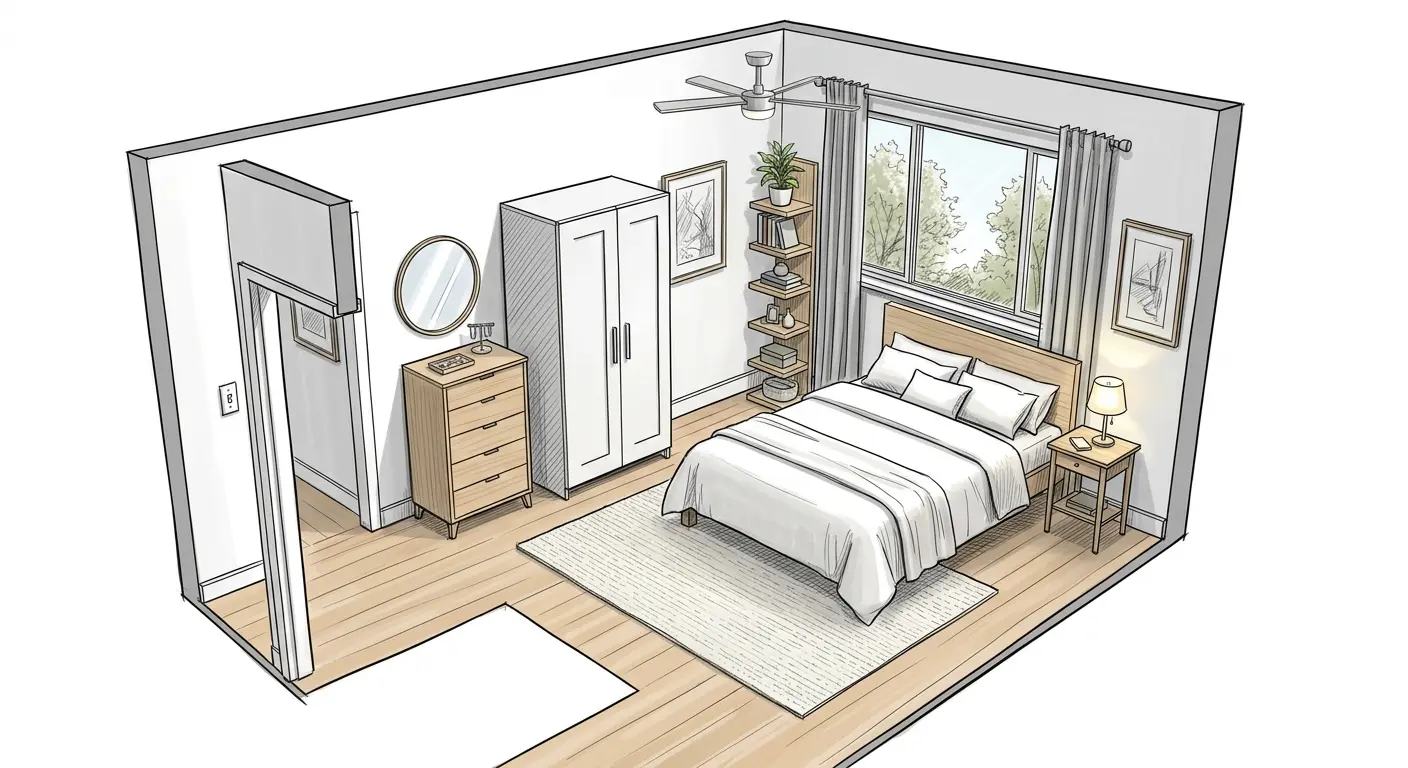
Many people avoid putting the bed under a window because of drafts or light in the morning. But handled correctly, this is actually one of the best bedroom layout ideas for small rooms available.
Here’s why it works: the window wall is almost always the most awkward one to use for large furniture like a wardrobe. So you free up that wall entirely for the bed, and you move your storage: wardrobe, dresser, mirror, to the opposite wall. The result is a clean, symmetrical layout with a clear 3-foot walking path between the foot of the bed and the storage furniture.
In the layout above, a compact wardrobe with a white finish sits flush against the far wall with a slim 4-drawer dresser beside it. A round wall-mounted mirror above the dresser bounces light across the room. That single mirror trick is one of the oldest, but it genuinely adds perceived depth to a small space.
For the drafts concern: hang blackout curtains from ceiling to floor, and they’ll act as a soft barrier. For the light concern: those same curtains solve it completely. Use a blackout lining and you’ll sleep just as well facing the window as you would facing a blank wall.
A ceiling fan with an integrated light kit, centered in the room, also helps when the bed is directly under a window as it improves air circulation and prevents that “stuffy corner” feeling during warm nights.
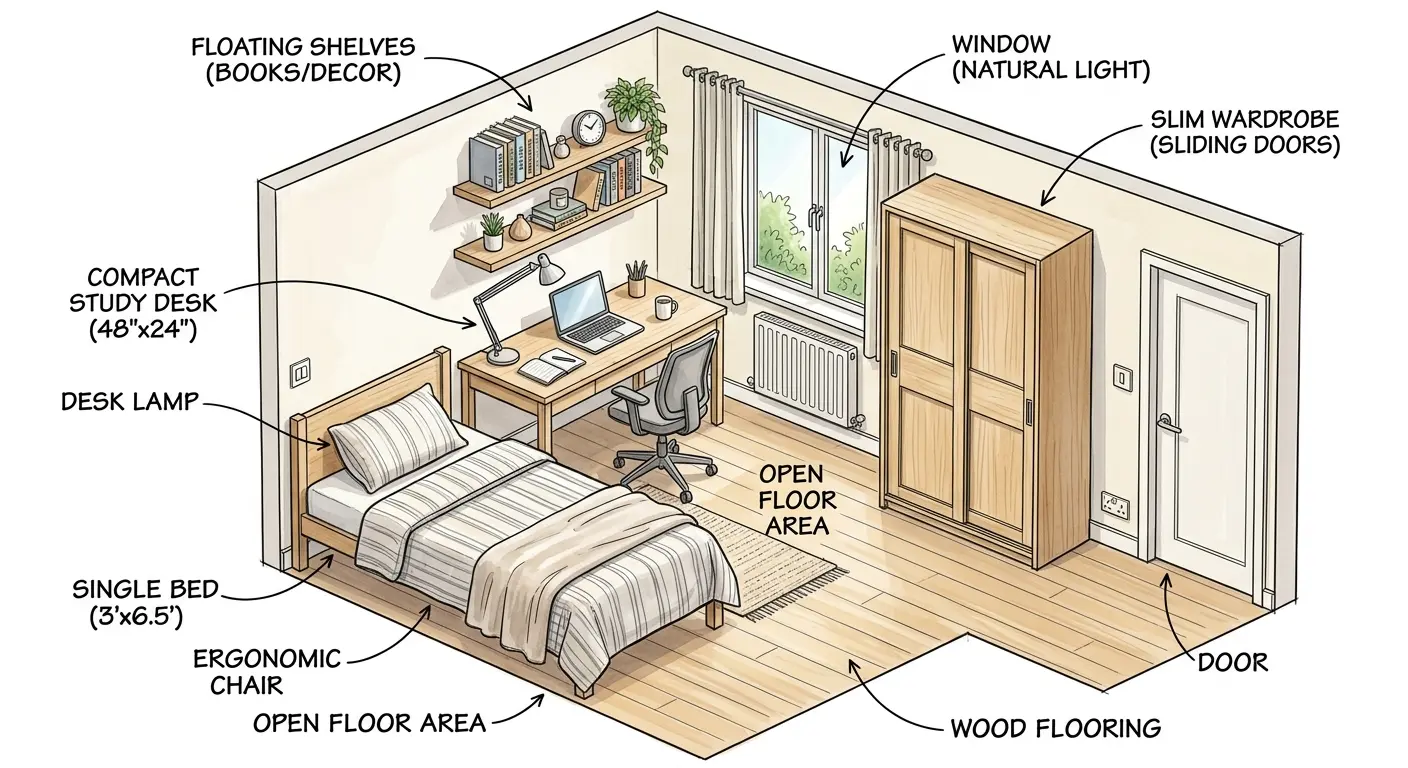
This layout is especially practical in a small bedroom that also needs to function as a workspace. The idea is to align the bed and the desk along the same wall, so that the opposite wall can be entirely dedicated to storage with a sliding-door wardrobe, and the center of the room stays completely clear.
The sketch above shows a single/twin bed against the left portion of the wall, and a 48 by 24 inch desk immediately beside it. Above the desk, two floating shelves carry books, a clock, and a small plant, keeping the desk surface clean. The chair tucks neatly under the desk when not in use, so it doesn’t intrude into the walkway.
Notice the wardrobe choice: sliding doors. This is a smart decision in a small room because swinging doors need clearance in front of them to open. In a tight space, that clearance can eat up the whole walking path. Sliding doors need zero swing room, which means you can walk right up to them. It’s one of those quiet decisions that makes a real difference day-to-day.
If you’re studying or working from this room often, add a warm-toned adjustable desk lamp. It keeps your workspace separate from the sleeping zone visually and helps your brain “switch modes” between work and rest, even in the same small room.
This is one of the most flexible bedroom layout ideas for small rooms, particularly for students, renters, or anyone working from a secondary bedroom. You get a full workspace without sacrificing a square inch of floor space more than you have to.
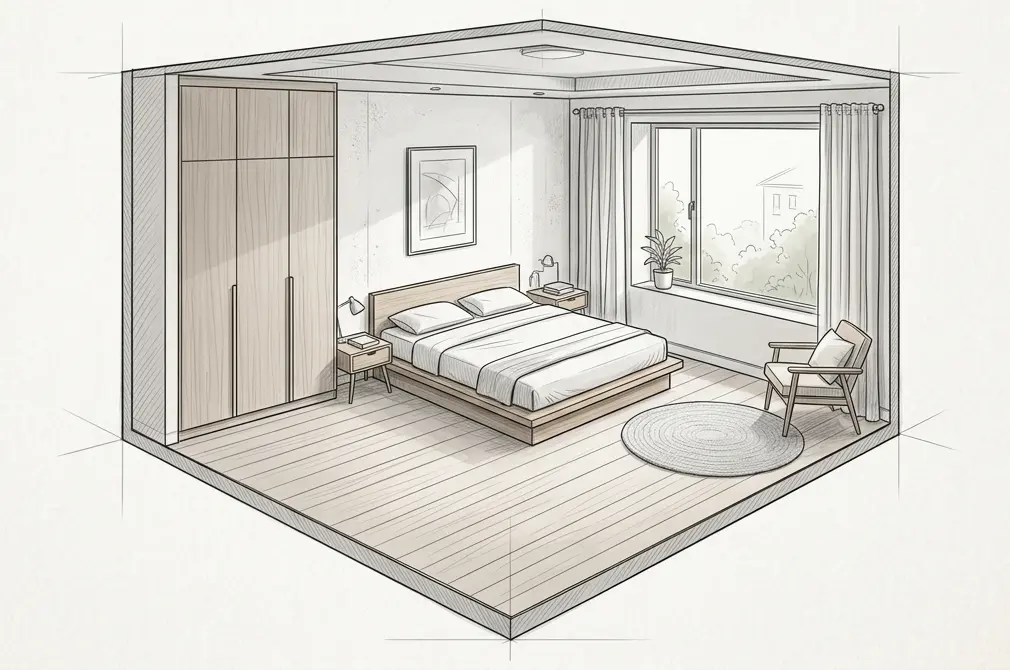
There’s a quiet visual trick at play in this layout: the lower the bed frame, the taller the room feels. When your bed sits close to the ground, roughly 30 centimeters high, more wall is visible above it. The ceiling looks further away. The room feels like it has room to breathe, even if it doesn’t technically have more of it.
In the layout shown, the platform bed (around 160 cm by 200 cm) anchors the main wall. Beside it on both sides, ultra-slim floating nightstands with task lamps replace traditional bedside tables. Along the left wall, a full-height built-in wardrobe uses flat-panel doors with a vertical grain, making it blend into the wall rather than jutting out visually as a separate piece of furniture.
The accent chair positioned at a 45-degree angle in the right corner adds a sense of human warmth. It breaks the rigidity of a room that can sometimes feel overly geometric when everything lines up in neat right angles. The round woven rug underneath it reinforces that softness, while also anchoring the chair visually so it doesn’t feel like it’s “floating” randomly in the corner.
For the bedroom layout ideas for small rooms, this one works especially well if you lean toward minimalist or Japandi-style design. The low bed, clean lines, and negative space around the furniture all create that “sanctuary” feeling even in a modest footprint.
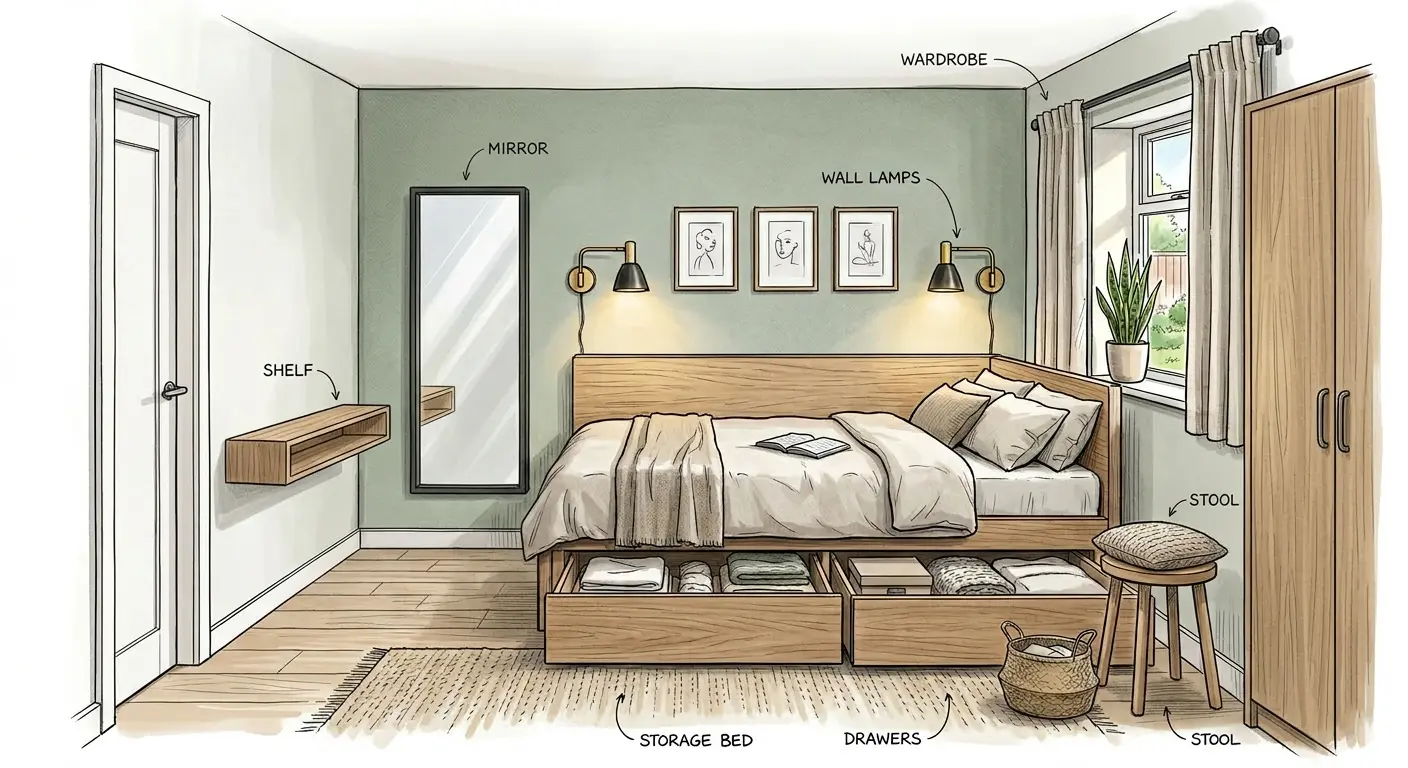
If you’re working with a bedroom under 10 square meters, every piece of furniture needs to earn its place. And nothing earns its place better than a storage bed: a platform frame with deep drawers built directly into the base.
The layout above shows two heavy-duty soft-close drawers running the full width of the bed base. These drawers are approximately 55 cm deep, which means they can hold folded linens, out-of-season clothes, and storage items that would otherwise require a separate dresser or under-bed boxes. The moment you remove the need for a freestanding dresser, you free up an entire wall section, and that changes how spacious the room feels entirely.
Against the side wall, a compact two-door wardrobe in light oak (roughly 90 cm wide) handles hanging clothes. A full-length black-framed mirror beside it, oriented vertically, creates one of the best optical illusions available to a small room: it doubles the perceived depth of the space. Stand in the doorway and the room feels twice as long.
There’s also a smart lighting choice in this layout: wall-mounted sconces hardwired above the bed, rather than table lamps sitting on surfaces. This keeps the bed area feeling clean and tidy, and means there’s no lamp base taking up space on a nightstand or shelf.
When choosing a storage bed, look for ones with full-extension drawer guides. Drawers that only pull out halfway don’t actually give you access to the back, which defeats the purpose. Full-extension means you can use every inch of that storage.
This is one of the most practical small bedroom layout ideas available for tight city apartments and compact homes where every cubic foot of storage matters.
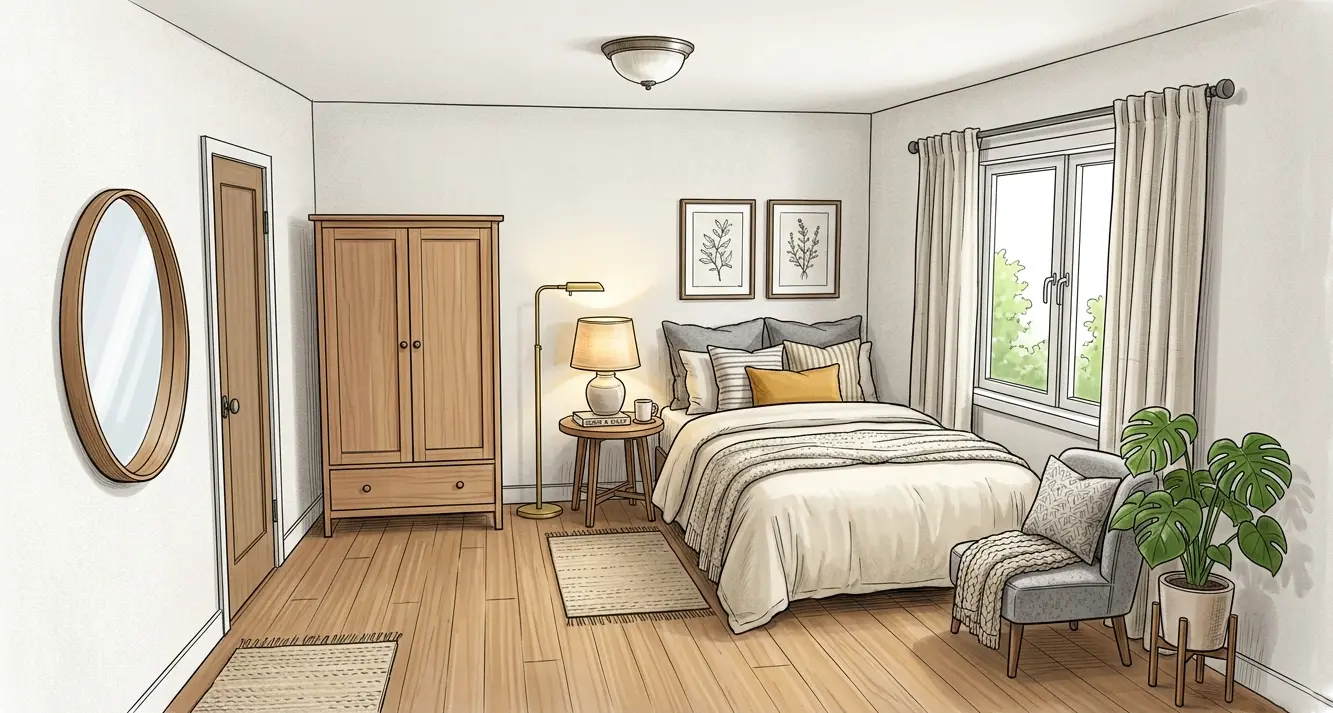
The final layout is for those of you who don’t just want your small room to function well. You want it to feel like somewhere you actually love to be. This one is for you.
The “cozy corner” layout works by grouping the functional elements (bed, wardrobe, mirror) efficiently, and then dedicating one real corner to a relaxation nook: an accent chair, a floor lamp, a small plant, and a throw. It sounds simple, but this single decision changes the whole atmosphere of the room.
In the layout above, the full-size bed sits in the right corner with layered bedding in grey, white, and mustard yellow. A small round pedestal side table sits flush against the bed with a ceramic lamp. The wardrobe is positioned on the left wall, a freestanding armoire with a bottom drawer, using the vertical space rather than spreading across the floor. A large circular wood-framed mirror near the door reflects the window’s natural light back across the room, expanding the visual depth noticeably.
The window nook holds a grey upholstered accent chair with a beige throw, angled toward the room rather than facing the wall. A Monstera plant in a white ceramic pot sits beside it on a mid-century wooden stand, placed directly in the path of natural light from the window.
What makes this work as one of the bedroom layout ideas for small rooms is the combination of two things: efficiency in the furniture placement, and deliberate warmth in the layering. The floor plan is practical. The textiles, the plant, the lamp, and the chair are what make it feel like a real room rather than just a place to sleep.
In a small room, stick to 3 main textures: something smooth like linen, something soft like wool, and something natural like jute. More than that and the room starts to feel busy. Three done well feels intentional and layered without being cluttered.
3 Universal Rules for Any Small Bedroom Layout
No matter which of these bedroom layout ideas for small rooms you end up using, these three rules apply across every single one of them:
Keep a 30-inch walking path, minimum
Interior designers and architects use 30 inches (about 76 cm) as the standard clearance for comfortable human movement. If the path from your door to your bed, or around the foot of the bed, is narrower than that, the room will feel claustrophobic even if it isn’t technically small. Measure before you move anything.
Use one large mirror strategically
A full-length or oversized mirror placed near a doorway, opposite a window, or beside a wardrobe does more for the perceived size of a small bedroom than almost any other single element. It reflects light, it creates depth, and it makes the room feel like it extends beyond itself. One well-placed mirror beats four small decorative ones every time.
Choose furniture that fits the room, not the other way around
A lot of people try to make a king-size bed work in a 10-square-meter room. It almost never does. Choosing a full or double instead of a king, or a slim wardrobe instead of a four-door behemoth, isn’t about settling. It’s about giving the room room to function. The right-sized furniture in a small room feels spacious. Oversized furniture in a small room just feels stuck.
The goal isn’t to fit everything you own into a small bedroom. The goal is to fit everything you actually use, in a way that makes the room feel considered and calm.
Your Small Room Has More Potential Than You Think
Small bedrooms get a bad reputation. People walk into them and immediately start thinking about what they can’t have: a sitting area, a big wardrobe, a desk. But that’s the wrong starting point.
Start instead with what you need, then let the layout serve those needs efficiently. Whether you go with the corner bed, a storage platform frame, floating shelves, or a full cozy nook, the transformation doesn’t require more space. It requires better decisions about the space you already have.
Pick one of these bedroom layout ideas for small rooms, measure your floor, and move one piece of furniture this week. That’s it. You’ll be surprised how much a single shift can change the way a room feels to live in.


Discussion
No comments yet. Be the first to share your thoughts!